Big Changes in Ocean Salinity Intensifying Water Cycle

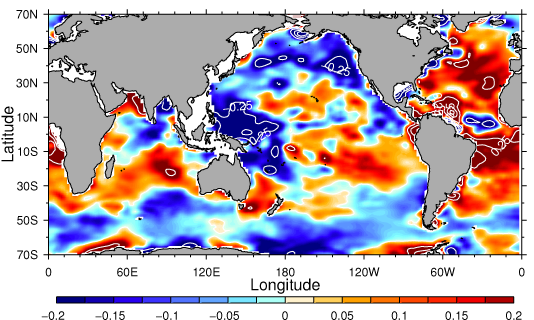
Surface salinity changes for 1950 to 2000. Red indicates regions becoming saltier, and blue regions becoming fresher: P.J. Durack, et al. 2012. Science. DOI:10.1126/science.1212222

Surface salinity changes from 1950 to 2000. Red shows regions becoming saltier, blue regions becoming fresher:  P.J. Durack, et al. Science. 2012. DOI:10.1126/science.1212222

A paper in Science today finds rapidly changing ocean salinities as a result of a warming atmosphere have intensified the global water cycle (evaporation and precipitation) by an incredible 4 percent between 1950 and 2000. That’s twice the rate predicted by models. 

These same models have long forecast that dry areas of Earth will become drier and wet areas wetter in a warming climate—an intensification of the water cycle driven mostly by the capacity of warmer air to hold and redistribute more moisture in the form of water vapor.
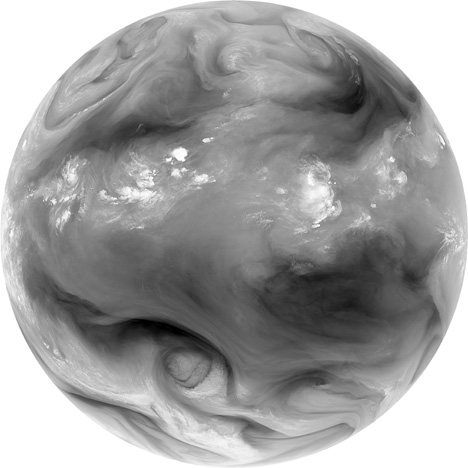
satellite image shows the distribution of water vapor over Africa and the Atlantic Ocean on  2 Sept 2010: NASASatellite image shows the distribution of water vapor over Africa and the Atlantic Ocean on 2 Sept 2010: NASA

But the rate of intensification of the global water cycle is happening far faster than imagined: at about 8 percent per degree Celsius of ocean warming since 1950.

At this rate, the authors calculate:

  • The global water cycle will intensify by a whopping 16 percent in a 2°C warmer world
  • The global water cycle will intensify by a frightening 24 percent in a 3°C warmer world
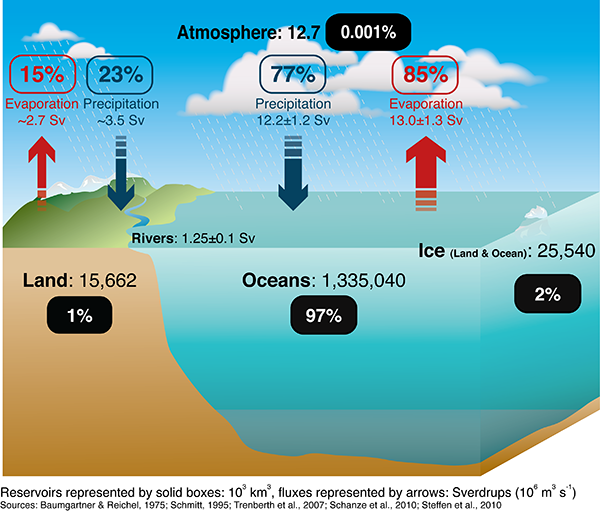
 

A schematic representation of the global water cycle, with the key role of the ocean and surface rainfall and evaporation fluxes expressed: Durack et al. Science. 2012. DOI:10.1126/science.1212222

A schematic representation of the global water cycle, with the key role of the ocean and surface rainfall and evaporation fluxes expressed: Durack et al. Science. 2012. DOI:10.1126/science.1212222 

The changes will not be uniform across the globe, but trend toward increased drying of arid areas and  increased flooding of wet areas.

And the resulting changes in freshwater availability are likely to be far more destabilizing to human societies and ecosystems than warming alone. 

“Changes to the global water cycle and the corresponding redistribution of rainfall will affect food availability, stability, access, and utilization,” says lead author Paul Durack at the University of Tasmania and the Lawrence Livermore National Laboratory.

The paper:

  • Paul J. Durack, Susan E. Wijffels and Richard J. Matear. Ocean Salinities Reveal Strong Global Water Cycle Intensification During 1950 to 2000. Science 2012. DOI:10.1126/science.1212222

4 DAYS LEFT—AND EVERYTHING RIDING ON IT

A full one-third of our annual fundraising comes in this month alone. That’s risky, because a strong December means our newsroom is on the beat and reporting at full strength—but a weak one means budget cuts and hard choices ahead.

With just 4 days left, we need a huge surge in reader support to get to our $400,000 year-end goal. Whether you've given before or this is your first time, your contribution right now matters. All gifts are 3X matched and tax-deductible.

Managing an independent, nonprofit newsroom is staggeringly hard. There’s no cushion in our budget—no backup revenue, no corporate safety net. We can’t afford to fall short, and we can’t rely on corporations or deep-pocketed interests to fund the fierce, investigative journalism Mother Jones exists to do. That’s why we need you right now. Please chip in to help close the gap.

4 DAYS LEFT—AND EVERYTHING RIDING ON IT

A full one-third of our annual fundraising comes in this month alone. That’s risky, because a strong December means our newsroom is on the beat and reporting at full strength—but a weak one means budget cuts and hard choices ahead.

With just 4 days left, we need a huge surge in reader support to get to our $400,000 year-end goal. Whether you've given before or this is your first time, your contribution right now matters. All gifts are 3X matched and tax-deductible.

Managing an independent, nonprofit newsroom is staggeringly hard. There’s no cushion in our budget—no backup revenue, no corporate safety net. We can’t afford to fall short, and we can’t rely on corporations or deep-pocketed interests to fund the fierce, investigative journalism Mother Jones exists to do. That’s why we need you right now. Please chip in to help close the gap.

We Recommend

Latest

Sign up for our free newsletter

Subscribe to the Mother Jones Daily to have our top stories delivered directly to your inbox.

Get our award-winning magazine

Save big on a full year of investigations, ideas, and insights.

Subscribe

Support our journalism

Help Mother Jones' reporters dig deep with a tax-deductible donation.

Donate