Obesity Drop Among 2-5-Year-Olds Is Even More Baffling Than I Thought


Last night I wrote about a new CDC study showing a 43 percent drop in obesity rates among 2-5 year-olds. It seemed inexplicably large to me, especially because no other age group showed any decline at all. Today, Zachary Goldfarb helpfully publishes a bit more of the data, and I’ve extracted two lines from his chart. This only deepens the mystery.
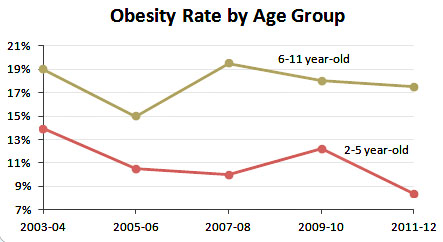
As you can see, there’s a fair amount of noise in the chart, and it’s possible that this explains the whole thing. But if we take the data seriously, you can see something even more dramatic than a 43 percent drop over a decade. Between 2003-04 and 2005-06, there’s a 25 percent drop. That’s a gigantic decline over the space of two years.

But there’s more. If there’s anything real going on here, you’d expect to see some kind of correlation between 2-5 year-olds and 6-11 year-olds with a time lag of a few years. But I don’t see anything. The 2005-06 cohort of 2-5 year-olds is noticeably less obese, but the 2007-12 cohort of 6-11 year-olds shows barely any change at all.

So this whole thing is very strange. As I said, it’s possible that noise is responsible for a lot of this. But even if there really is something going on, it doesn’t seem to be having any impact at all once children get a few years older. That’s both strange and disappointing. I wouldn’t expect miracles, but the whole point of obesity interventions in small children is that it prevents a lifetime of bad habits. As the New York Times put it, “New evidence has shown that obesity takes hold young: Children who are overweight or obese at 3 to 5 years old are five times as likely to be overweight or obese as adults.” But if that’s true, it sure isn’t showing up in the data. As near as I can tell, reducing obesity among 2-5 year-olds has precisely zero effect on obesity later in childhood.

4 DAYS LEFT—AND EVERYTHING RIDING ON IT

A full one-third of our annual fundraising comes in this month alone. That’s risky, because a strong December means our newsroom is on the beat and reporting at full strength—but a weak one means budget cuts and hard choices ahead.

With just 4 days left, we need a huge surge in reader support to get to our $400,000 year-end goal. Whether you've given before or this is your first time, your contribution right now matters. All gifts are 3X matched and tax-deductible.

Managing an independent, nonprofit newsroom is staggeringly hard. There’s no cushion in our budget—no backup revenue, no corporate safety net. We can’t afford to fall short, and we can’t rely on corporations or deep-pocketed interests to fund the fierce, investigative journalism Mother Jones exists to do. That’s why we need you right now. Please chip in to help close the gap.

4 DAYS LEFT—AND EVERYTHING RIDING ON IT

A full one-third of our annual fundraising comes in this month alone. That’s risky, because a strong December means our newsroom is on the beat and reporting at full strength—but a weak one means budget cuts and hard choices ahead.

With just 4 days left, we need a huge surge in reader support to get to our $400,000 year-end goal. Whether you've given before or this is your first time, your contribution right now matters. All gifts are 3X matched and tax-deductible.

Managing an independent, nonprofit newsroom is staggeringly hard. There’s no cushion in our budget—no backup revenue, no corporate safety net. We can’t afford to fall short, and we can’t rely on corporations or deep-pocketed interests to fund the fierce, investigative journalism Mother Jones exists to do. That’s why we need you right now. Please chip in to help close the gap.

We Recommend

Latest

Sign up for our free newsletter

Subscribe to the Mother Jones Daily to have our top stories delivered directly to your inbox.

Get our award-winning magazine

Save big on a full year of investigations, ideas, and insights.

Subscribe

Support our journalism

Help Mother Jones' reporters dig deep with a tax-deductible donation.

Donate