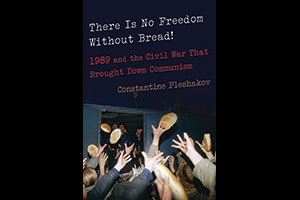
Books: There Is No Freedom Without Bread! 1989 and the Civil War That Brought Down Communism

Historian Constantine Pleshakov examines the last days of the Iron Curtain.

Get your news from a source that’s not owned and controlled by oligarchs. Sign up for the free Mother Jones Daily.


Ever since Ronald Reagan’s “tear down this wall” speech in 1987, many Americans have viewed it as the moment that precipitated the collapse of communism in Eastern Europe. Yet on the 20th anniversary of the fall of the Berlin Wall, it’s instructive to remember that Reagan’s address simply “did not cause much of a stir in the Soviet Union,” as Russian-born historian Constantine Pleshakov explains in this enlightening look at the last days of the Iron Curtain, as seen from outside the prism of American politics.

In his revisionist retelling, the collapse of communist rule had more to do with long-simmering local conflicts, such as Polish labor disputes, than pressure from abroad. “Rebellion was a domestic matter,” Pleshakov writes. Augmenting rich historical detail with pop-culture and literary allusions, he traces the decline of postwar communism from the 1956 Hungarian uprising and the 1968 Prague Spring through the rise of Solidarity and the disastrous Afghan war. He doesn’t write off the influence of the West—Richard Nixon’s 1959 visit to Warsaw drew a quarter of a million people into the streets, some cheering, “Long live Nixon!”—and he gives Reagan credit for inspiring Eastern Europeans. Yet his main protagonist is Pope John Paul II, whom he declares “a miracle” for his canny understanding of the social and religious forces that would spur Poles to revolt.

The book’s title, a play on a Solidarity slogan (“There Is No Bread Without Freedom”), emphasizes Pleshakov’s point that the “correlation between prosperity and liberty is never simple.” After World War II, many Eastern Europeans accepted the trade-off between liberty and the stability offered by communism. He’s not excusing communism, just correcting the idea that such a dichotomy could be easily stood on its head. As he concludes, “Free elections do not necessarily lead to more freedom and…the free market can impoverish a nation as effectively as central planning.”

If you buy a book using our Bookshop link, a small share of the proceeds supports our journalism.

YOUR GIFT DOUBLES THROUGH FRIDAY

Right now, every dollar you give goes twice as far—but only until Friday’s midnight deadline. This is the moment to make your support count double.

In a climate where journalists face mounting pressure to back down, stay silent, or soften their reporting, Mother Jones refuses to flinch. We’re pushing back against intimidation and delivering fierce, independent journalism that holds power accountable—no matter who’s trying to silence us.

But here’s the reality: We’re a nonprofit newsroom with zero corporate backing and no financial cushion. We depend entirely on readers like you to fund the investigations that matter most.

Friday’s 2X match deadline is coming soon. We need you on the team right now. Please chip in and double your impact.

YOUR GIFT DOUBLES THROUGH FRIDAY

Right now, every dollar you give goes twice as far—but only until Friday’s midnight deadline. This is the moment to make your support count double.

In a climate where journalists face mounting pressure to back down, stay silent, or soften their reporting, Mother Jones refuses to flinch. We’re pushing back against intimidation and delivering fierce, independent journalism that holds power accountable—no matter who’s trying to silence us.

But here’s the reality: We’re a nonprofit newsroom with zero corporate backing and no financial cushion. We depend entirely on readers like you to fund the investigations that matter most.

Friday’s 2X match deadline is coming soon. We need you on the team right now. Please chip in and double your impact.

We Recommend

Latest

Sign up for our free newsletter

Subscribe to the Mother Jones Daily to have our top stories delivered directly to your inbox.

Get our award-winning magazine

Save big on a full year of investigations, ideas, and insights.

Subscribe

Support our journalism

Help Mother Jones' reporters dig deep with a tax-deductible donation.

Donate