
Was there a huge crime wave in 2015? There are two main sources for crime rates in the United States. The FBI produces the Uniform Crime Report (UCR), which is based on reporting from police agencies. The Bureau of Justice Statistics produces the National Crime Victimization Survey (NCVS), which conducts surveys of ordinary Americans and asks if they’ve been a crime victim in the past year. Rick Nevin breaks down the numbers:
The 2015 NCVS property crime rate (household burglary, motor vehicle theft, and other theft) was down 6.3% from 2014…2015 UCR burglary rate…down 8.5%…UCR larceny-theft rate…down 2.5%…UCR property crime rate…down 3.4% from 2014….roughly consistent with the NCVS data showing the property crime rate falling 6.3% in 2015 to a record low.
The UCR violent crime rate (murder, rape, robbery, and aggravated assault) should be roughly consistent with the NCVS serious violent crime rate (sexual assault, robbery, and aggravated assault),¹ but the UCR violent crime rate increased 3.0% in 2015 as the NCVS serious violent crime rate fell 11.7%….
OK, hold on. Everyone agrees that property crime is down, but the FBI says the reported violent crime rate increased 3 percent while the NCVS survey data says it decreased 11.7 percent? What’s going on? The biggest components of the violent crime index are robbery and aggravated assault. Both the UCR and the NCVS agree closely about the robbery rate, so that means there must be some kind of discrepancy in the aggravated assault rate:
The 2015 UCR aggravated assault rate was up 3.8% from 2014….NCVS total aggravated assaults were down 25.2% in 2015, and NCVS aggravated assaults reported to police were down 20.7%.
Yikes! Long story short, Nevin shows that this divergence between UCR and NCVS has been increasing for the past decade. The culprit, apparently, is exactly the opposite of the frequent allegation that police departments understate serious crime in order to make themselves look better. “The fact that NCVS victims are reporting aggravated assaults far below UCR recorded aggravated assaults suggests that police have become far more expansive than crime victims are when it comes to defining aggravated assault, perhaps to protect against allegations that the police undercount serious violent crime.”
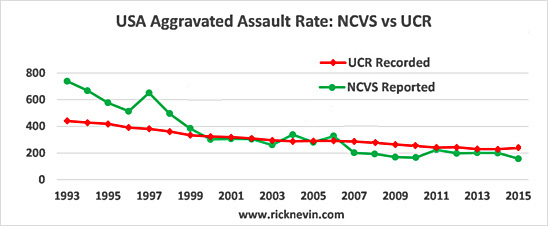
Most likely, then, there’s a longstanding issue of how aggravated assault is reported and categorized. Basically, police departments underreported it in the past and are now overreporting it. Aggravated assault probably decreased or held steady in 2015, which means the overall rate of violent crime was also either down or steady.
There was an increase in the murder rate last year, from 4.44 in 2014 to 4.88 in 2015 (per 100,000). This is a significant jump, and it was apparently fueled by an especially large jump in about a dozen big cities. This is cause for concern, especially since the murder rate usually correlates roughly with the overall violent crime rate. The divergence last year is unusual, and we don’t yet know what explains it. It might just be a random spike, or it could suggest something worse.
But while murder gets the headlines, it’s only one small component of the overall crime rate. Overall property crime was down last year and overall violent crime was probably down too. These are, by far, the crimes that actually affect most people. With the exception of a few pockets of increased homicide, America continues to get safer and safer.
¹The NCVS numbers don’t include homicide because you obviously can’t survey murder victims. However, homicide is a tiny part of the overall violent crime rate, so that doesn’t account for the difference between UCR and NCVS figures.