Julia Whitty
Barataria Bay, Louisiana. Yesterday Captain Dave Marino (below, left) took cinematographer Larry Curtis and me out to see the birds breeding on the little islands in the oil spill zone of the Mississippi River Delta.


(Photo by Lawrence Curtis)
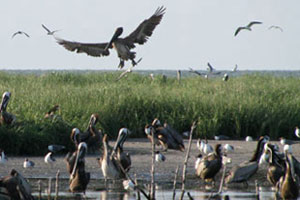
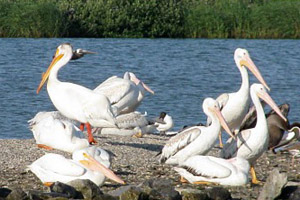
The brown pelicans, white pelicans, great egrets, snowy egrets, roseate spoonbills, white ibis, ospreys, laughing gulls, and various terns and assorted shorebirds are working overtime right now to feed their hatchlings. It’s an ancient rite of spring on the water down here in southernmost Louisiana.


But there’s something new to the birds’ world this year: These weird floating booms surrounding (only some of) their islands.The yellow boom supposedly acts as a dam holding the oil away. The white boom is absorbent to oil.

The oil on the yellow boom doesn’t look too bad now. Captain Dave—a redfish and trout fishing guide who knows these waters better than his wife’s freckles (okay, I made that up)—tells me BP crews are changing the yellow booms regularly so they won’t look so filthy when camera crews come by.

The subterfuge doesn’t hide the real problem, he said. Which is that there’s more oil inside the booms than outside. The booms were put in place only after the oil came in. Even though every fishing boat in the northern hemisphere had been waiting on standby weeks ago, desperate to jump on whatever they could do to protect the fisheries, the shore, their world, their livelihood. No doing. BP waited too long, said Dave. In the photo above you can see oil inside the boom.


Some of the birds preening on the shores of these breeding islands were clearly oiled.

Those that aren’t oiled on the outside are likely oiled on the inside, since they’re catching fish and invertebrates exposed to oil and dispersant. This white ibis—known in the Cajun dialect as a crawbay (?) croixbet (?), no idea about the spelling of that—will be poking into the contaminated seafloor for food long after the surface waters look clean.

We saw many flocks of ibis heading out to waters of unknown oily provenance to fish.

(Photo courtesy Lawrence Curtis)
This roseate spoonbill and many others like it were also flying towards the same unknowns.

All the birds here make a living off the sea and all will be carrying their catch—contaminated or otherwise—back to feed their chicks, like this baby brown pelican.

Dave kept wondering what exactly these booms were going to do. Some islands are boomed, others are not. Some are partially boomed. That’s like wearing half a condom, if you know what I mean. Lost booms are floating around all over the place out here, fouling the fouled waters.

Darkness and huge thunderstorms brought down the curtain on a million questions about the future. Dave said—and the birds would doubtless agree—he’d rather have another Katrina than this. Sadly, 2010 may deliver both.