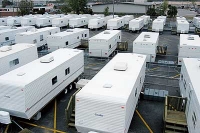
 Talk about adding insult to injury. It’s been more than two years since Hurricane Katrina forced Gulf Coast residents out of their homes, and tens of thousands of them are still living in FEMA trailers today. As if that weren’t bad enough, those trailers might be making people sick. FEMA trailer residents—especially kids—have been complaining of breathing problems, headaches, rashes, and allergies.
The EPA has tested trailers for formaldehyde—but strangely, only the empty ones. This led to a showdown between Rep. Henry Waxman (D-CA) and FEMA Director David Paulison at a House Oversight and Government Reform Committee federal hearing last summer:
“Did you test any other occupied trailers?” Waxman asked Paulison.
“We did not test occupied trailers,” Paulson replied. “We went along with the advice that we received from EPA and CDC that if we ventilated the trailers that would reduce the formaldehyde issue.”
Waxman pressed on, asking Paulison if FEMA tested to see whether ventilating the trailers in fact reduced formaldehyde levels. Paulison said that it did reduce levels in the empty trailers.
But Waxman interrupted the response, repeating that FEMA tests were conducted only on empty trailers with blowing fans, open windows and constant air conditioning.
Since the summer, there’s been an outcry about the formaldehyde problem. The press has picked up the story, and at least one blog about toxic trailers exists.
In its “For the Record” release about formaldehyde, FEMA recommends that residents “increase ventilation,” “keep indoor temperatures cool,” and “keep the humidity low.” Easy as pie. Unless, of course, you happen to live in cramped quarters in a subtropical climate.