Human Superbug Started On Farms

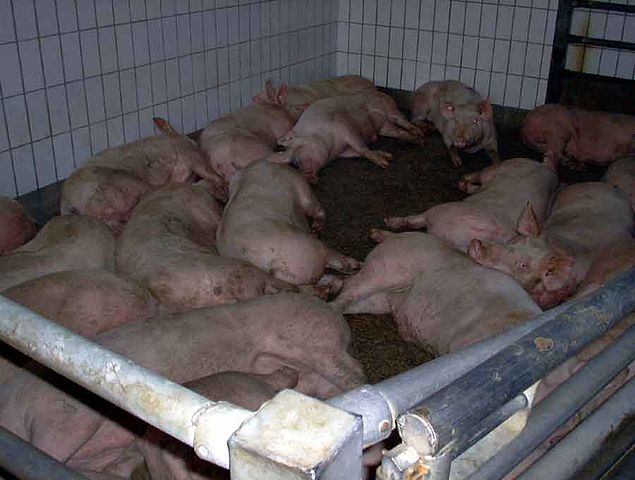
Pigs in a factory farm.Credit: <a href="http://commons.wikimedia.org/wiki/User:Maqi">Maqi</a> via <a href="http://commons.wikimedia.org/wiki/File:Pigs-lying.jpg">Wikimedia Commons</a>.

Get your news from a source that’s not owned and controlled by oligarchs. Sign up for the free Mother Jones Daily.


It’s long been suspected that administering large amounts of antibiotics to livestock promotes antibiotic resistance.

Now a new paper in mBio describes how a particularly nasty strain of MRSA—the CC398 strain found primarily in pigs but also in cattle and poultry—likely did that. 

Sequencing the genomes of 88 closely-related strains of S. aureus, the researchers found the CC398 strain likely originated as a harmless bacterium living in humans, which acquired antibiotic resistance only after it migrated into livestock. From there it migrated back to humans, where it now causes skin infections and sepsis, mostly in farm workers.

So far the strain has not evolved the ability to transmit between humans.

From the paper:

The CC398 strain of MRSA, which appeared in 2003, is now commonplace in US livestock. 

Modern food animal production is characterized by densely concentrated animals and routine antibiotic use, which may facilitate the emergence of novel antibiotic-resistant zoonotic pathogens. Our findings strongly support the idea that livestock-associated MRSA CC398 originated as MSSA in humans. The jump of CC398 from humans to livestock was accompanied by the loss of phage-carried human virulence genes, which likely attenuated its zoonotic potential, but it was also accompanied by the acquisition of tetracycline and methicillin resistance. Our findings exemplify a bidirectional zoonotic exchange and underscore the potential public health risks of widespread antibiotic use in food animal production.

Last month the FDA announced new restrictions on antibiotics in livestock. But New Scientists reports these rules cover only 0.2 percent of antibiotics used on farms in the US.

The paper:

  • Price LB, et al. 2012. Staphylococcus aureus CC398: host adaptation and emergence of methicillin resistance in livestock. mBio 3(1):e00305-11. doi:10.1128/mBio.00305-11.
YOUR GIFT DOUBLES THROUGH FRIDAY

Right now, every dollar you give goes twice as far—but only until Friday’s midnight deadline. This is the moment to make your support count double.

In a climate where journalists face mounting pressure to back down, stay silent, or soften their reporting, Mother Jones refuses to flinch. We’re pushing back against intimidation and delivering fierce, independent journalism that holds power accountable—no matter who’s trying to silence us.

But here’s the reality: We’re a nonprofit newsroom with zero corporate backing and no financial cushion. We depend entirely on readers like you to fund the investigations that matter most.

Friday’s 2X match deadline is coming soon. We need you on the team right now. Please chip in and double your impact.

YOUR GIFT DOUBLES THROUGH FRIDAY

Right now, every dollar you give goes twice as far—but only until Friday’s midnight deadline. This is the moment to make your support count double.

In a climate where journalists face mounting pressure to back down, stay silent, or soften their reporting, Mother Jones refuses to flinch. We’re pushing back against intimidation and delivering fierce, independent journalism that holds power accountable—no matter who’s trying to silence us.

But here’s the reality: We’re a nonprofit newsroom with zero corporate backing and no financial cushion. We depend entirely on readers like you to fund the investigations that matter most.

Friday’s 2X match deadline is coming soon. We need you on the team right now. Please chip in and double your impact.

We Recommend

Latest

Sign up for our free newsletter

Subscribe to the Mother Jones Daily to have our top stories delivered directly to your inbox.

Get our award-winning magazine

Save big on a full year of investigations, ideas, and insights.

Subscribe

Support our journalism

Help Mother Jones' reporters dig deep with a tax-deductible donation.

Donate