Get your news from a source that’s not owned and controlled by oligarchs. Sign up for the free Mother Jones Daily.

Over at Cato, Daniel Mitchell posts the chart below and says it shows just how worthless Obama’s economic stimulus package was. “As you can see, the unemployment rate is about 2.5 percentage points higher than the White House claimed it would be at this point.”
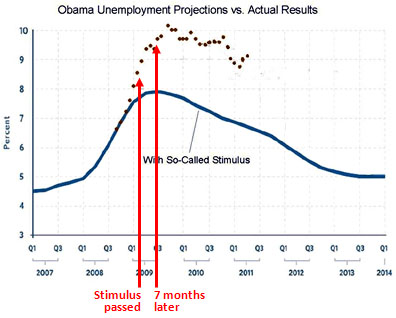
This has become such a popular meme on the right that I suppose it’s pointless to argue with it. But seriously. This chart shows the exact opposite of what Mitchell claims. I mean, just take a look at the data itself. By the time the stimulus bill had passed, unemployment was already a point higher than projections. By the end of Q3, about the earliest point that anyone thinks the stimulus might have really started working its way through the system, unemployment was already nearly two points higher. All of this happened before the stimulus could plausibly have had any significant impact on employment, either positive or negative.
(CBO’s tiny estimates for Q2 and Q3 of 2009 are here.)
The post-collapse recession, unfortunately, was simply far bigger than the Obama administration predicted.

After that, unemployment quickly peaked and started to come down. Did it come down faster because of the stimulus? Most models of the economy say yes, though feel free to argue if you prefer a different model. But what you can’t argue is that the stimulus was ineffective because it didn’t have an effect before it even started. This is economics, after all, not science fiction. What this chart really suggests isn’t that the stimulus didn’t work, but rather that (a) the 2008-09 recession turned out to be way worse than anyone thought in late 2008, and (b) the stimulus package was too small. We’re still paying the price for that mistake.

Via Peter Suderman.

DECEMBER IS MAKE OR BREAK

A full one-third of our annual fundraising comes in this month alone. That’s risky, because a strong December means our newsroom is on the beat and reporting at full strength—but a weak one means budget cuts and hard choices ahead.

With only days left until December 31, we've raised about half of our $400,000 goal—but we need a huge surge in reader support to close the remaining gap. Whether you've given before or this is your first time, your contribution right now matters.

Managing an independent, nonprofit newsroom is staggeringly hard. There’s no cushion in our budget—no backup revenue, no corporate safety net. We can’t afford to fall short, and we can’t rely on corporations or deep-pocketed interests to fund the fierce, investigative journalism Mother Jones exists to do. That’s why we need you right now. Please chip in to help close the gap.

DECEMBER IS MAKE OR BREAK

A full one-third of our annual fundraising comes in this month alone. That’s risky, because a strong December means our newsroom is on the beat and reporting at full strength—but a weak one means budget cuts and hard choices ahead.

With only days left until December 31, we've raised about half of our $400,000 goal—but we need a huge surge in reader support to close the remaining gap. Whether you've given before or this is your first time, your contribution right now matters.

Managing an independent, nonprofit newsroom is staggeringly hard. There’s no cushion in our budget—no backup revenue, no corporate safety net. We can’t afford to fall short, and we can’t rely on corporations or deep-pocketed interests to fund the fierce, investigative journalism Mother Jones exists to do. That’s why we need you right now. Please chip in to help close the gap.

We Recommend

Latest

Sign up for our free newsletter

Subscribe to the Mother Jones Daily to have our top stories delivered directly to your inbox.

Get our award-winning magazine

Save big on a full year of investigations, ideas, and insights.

Subscribe

Support our journalism

Help Mother Jones' reporters dig deep with a tax-deductible donation.

Donate