Chart of the Day: The End of Fish?


Brad Plumer takes a look today at recent research on overfishing:

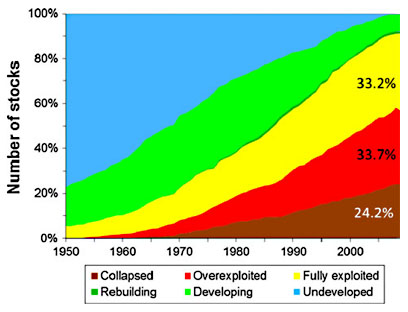
Ideally, we’d have in-depth stock assessments for the entire world, but those are difficult, expensive, and fairly rare. So, in their paper, Pitcher and Cheung review a number of recent studies that use indirect measurements instead. For example, they note that recent analyses of fish catches suggest that about 58 percent of the world’s fish stocks have now collapsed or are overexploited.

Note that 91 percent of all fish stocks today are either fully exploited or overexploited. There are some success stories of fish stocks being rebuilt, but that’s the almost invisible dark green line near the top. It represents less than 1 percent of all global fish stocks.

But all is not lost. Most of these success stories are in advanced economies, including the U.S., Australia, Canada, and Norway, which is exactly where you’d expect progress to begin. Low-income countries lag behind, but that may change as the success stories start to percolate downward:

Yet many low-income countries lack the resources to monitor their fisheries. And even richer nations struggle to enforce the laws they have: In Europe, regulators have consistently set lax fishing quotas — in part due to lobbying from the fishing industry. (“Europe is not one of the places that’s doing well,” says Pitcher, “with a few exceptions like Norway.”) Meanwhile, as climate change warms the ocean and disrupts ecosystems in unpredictable ways, regulating fisheries may become even more difficult.

“Attempts to remedy the situation need to be urgent, focused, innovative, and global,” the paper concludes. But that’s harder than it sounds.

Yes it is.

DECEMBER IS MAKE OR BREAK

A full one-third of our annual fundraising comes in this month alone. That’s risky, because a strong December means our newsroom is on the beat and reporting at full strength—but a weak one means budget cuts and hard choices ahead.

With only days left until December 31, we've raised about half of our $400,000 goal—but we need a huge surge in reader support to close the remaining gap. Whether you've given before or this is your first time, your contribution right now matters.

Managing an independent, nonprofit newsroom is staggeringly hard. There’s no cushion in our budget—no backup revenue, no corporate safety net. We can’t afford to fall short, and we can’t rely on corporations or deep-pocketed interests to fund the fierce, investigative journalism Mother Jones exists to do. That’s why we need you right now. Please chip in to help close the gap.

DECEMBER IS MAKE OR BREAK

A full one-third of our annual fundraising comes in this month alone. That’s risky, because a strong December means our newsroom is on the beat and reporting at full strength—but a weak one means budget cuts and hard choices ahead.

With only days left until December 31, we've raised about half of our $400,000 goal—but we need a huge surge in reader support to close the remaining gap. Whether you've given before or this is your first time, your contribution right now matters.

Managing an independent, nonprofit newsroom is staggeringly hard. There’s no cushion in our budget—no backup revenue, no corporate safety net. We can’t afford to fall short, and we can’t rely on corporations or deep-pocketed interests to fund the fierce, investigative journalism Mother Jones exists to do. That’s why we need you right now. Please chip in to help close the gap.

We Recommend

Latest

Sign up for our free newsletter

Subscribe to the Mother Jones Daily to have our top stories delivered directly to your inbox.

Get our award-winning magazine

Save big on a full year of investigations, ideas, and insights.

Subscribe

Support our journalism

Help Mother Jones' reporters dig deep with a tax-deductible donation.

Donate