Map of the Day: How We Get Hurt

Get your news from a source that’s not owned and controlled by oligarchs. Sign up for the free Mother Jones Daily.


Amino is a health care startup dedicated to “making health care simple and intuitive using data, design, and a whole lot of empathy.” Yesterday they posted the following map:
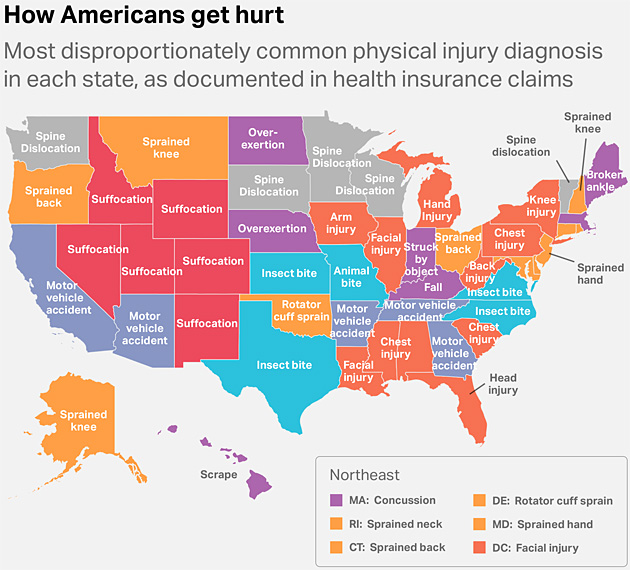
This is not the most common form of injury, which is “bruising” or “open wound” in nearly every state. It’s the type of injury that each state has in unusually high numbers compared to other states. California, for example, has lots of motor vehicle accidents, which should surprise no one. Likewise, Florida is a leader in head injuries, which is equally unsurprising.

But what’s up with the Rocky Mountain suffocation belt? Amino’s Olivia Marcus explains:

Some broad trends stand out, including the prevalence of “suffocation” (a broad category related to oxygen deficiency) in six of the eight Mountain states: Nevada, Idaho, Utah, Wyoming, Colorado, and New Mexico. Diagnoses related to “suffocation” were 1.8 times more common in Idaho compared to the national distribution, and 3.1 times more common in Utah. The other four states fell somewhere in the middle.

We can’t say for sure why this is. But the vast majority of “suffocation” diagnoses were for hypoxemia, the medical term for low blood oxygen. Interestingly, hypoxemia can be caused by exertion at high altitudes, where oxygen is scarce. We can’t prove that this is correlated to the altitude of Mountain states, but it could be related.

OK, so all those Mountain Staters aren’t being suffocated in their beds or anything. They’re just suffering from temporary oxygen deficiency. And those six states are indeed the ones with the highest mean elevation in America:
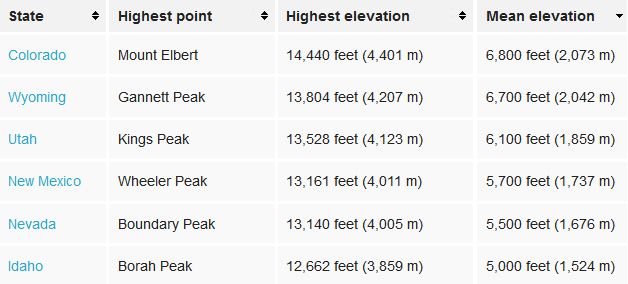
So yeah: exertion at high altitudes appears to be the culprit here. I guess they call them Mountain States for a reason.

DECEMBER IS MAKE OR BREAK

A full one-third of our annual fundraising comes in this month alone. That’s risky, because a strong December means our newsroom is on the beat and reporting at full strength—but a weak one means budget cuts and hard choices ahead.

With only days left until December 31, we've raised about half of our $400,000 goal—but we need a huge surge in reader support to close the remaining gap. Whether you've given before or this is your first time, your contribution right now matters.

Managing an independent, nonprofit newsroom is staggeringly hard. There’s no cushion in our budget—no backup revenue, no corporate safety net. We can’t afford to fall short, and we can’t rely on corporations or deep-pocketed interests to fund the fierce, investigative journalism Mother Jones exists to do. That’s why we need you right now. Please chip in to help close the gap.

DECEMBER IS MAKE OR BREAK

A full one-third of our annual fundraising comes in this month alone. That’s risky, because a strong December means our newsroom is on the beat and reporting at full strength—but a weak one means budget cuts and hard choices ahead.

With only days left until December 31, we've raised about half of our $400,000 goal—but we need a huge surge in reader support to close the remaining gap. Whether you've given before or this is your first time, your contribution right now matters.

Managing an independent, nonprofit newsroom is staggeringly hard. There’s no cushion in our budget—no backup revenue, no corporate safety net. We can’t afford to fall short, and we can’t rely on corporations or deep-pocketed interests to fund the fierce, investigative journalism Mother Jones exists to do. That’s why we need you right now. Please chip in to help close the gap.

We Recommend

Latest

Sign up for our free newsletter

Subscribe to the Mother Jones Daily to have our top stories delivered directly to your inbox.

Get our award-winning magazine

Save big on a full year of investigations, ideas, and insights.

Subscribe

Support our journalism

Help Mother Jones' reporters dig deep with a tax-deductible donation.

Donate