Revisiting the Great Inflection Year of 2000

Scott Winship passes along a new analysis of the “deaths of despair” thesis made famous a couple of years ago by Anne Case and Angus Deaton. He has a new chart that shows various trends going back to 1900:
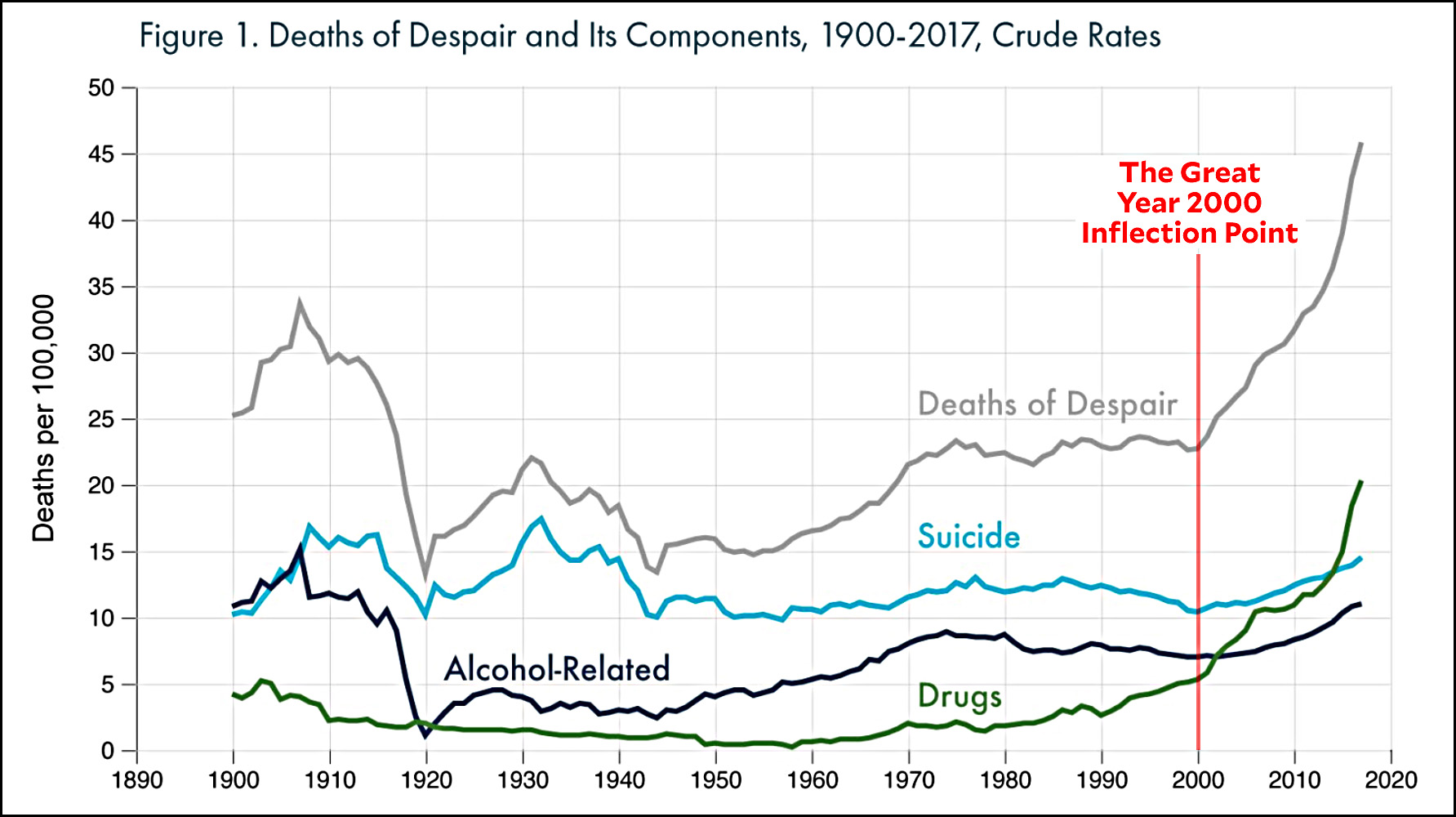
Winship’s main point is that, taken on a historical basis, alcohol deaths and suicide aren’t really way out of line. What’s more, there’s little evidence that overall happiness or overall economic wellbeing have changed significantly in recent years. What has skyrocketed is drug-related deaths, which means we should be paying attention to opioids, not to “despair” in general.

That may be, and I don’t want to offer an opinion on this particular topic. But Winship’s chart brought back memories of something that’s nibbled at the back of my mind for a long time: the great year 2000 inflection point. It may be true that suicide and alcohol-related deaths are at historically normal levels, but it’s also true that every single trendline in this chart inflected almost precisely at the year 2000.

And that’s not all. Several years ago I noted a surprisingly large set of economic trends that also inflected in the year 2000. I had a hard time coming up with a coherent explanation for this, and plenty of people thought my list was mostly just coincidental. Maybe so. But although I’ve moved on to other things, I do sometimes notice yet another trend that started right around 2000. And now here’s another one.

I still can’t help but feel that something non-obvious happened around the year 2000 to produce a sea change in both the global economy and our response to it. Whatever it is, perhaps it’s what finally came home to roost around 2016 and gave us Trump and Brexit and Viktor Orban and so forth. But I confess that I’m no closer to an answer today than I was eight years ago.
DECEMBER IS MAKE OR BREAK

A full one-third of our annual fundraising comes in this month alone. That’s risky, because a strong December means our newsroom is on the beat and reporting at full strength—but a weak one means budget cuts and hard choices ahead.

With only days left until December 31, we've raised about half of our $400,000 goal—but we need a huge surge in reader support to close the remaining gap. Whether you've given before or this is your first time, your contribution right now matters.

Managing an independent, nonprofit newsroom is staggeringly hard. There’s no cushion in our budget—no backup revenue, no corporate safety net. We can’t afford to fall short, and we can’t rely on corporations or deep-pocketed interests to fund the fierce, investigative journalism Mother Jones exists to do. That’s why we need you right now. Please chip in to help close the gap.

DECEMBER IS MAKE OR BREAK

A full one-third of our annual fundraising comes in this month alone. That’s risky, because a strong December means our newsroom is on the beat and reporting at full strength—but a weak one means budget cuts and hard choices ahead.

With only days left until December 31, we've raised about half of our $400,000 goal—but we need a huge surge in reader support to close the remaining gap. Whether you've given before or this is your first time, your contribution right now matters.

Managing an independent, nonprofit newsroom is staggeringly hard. There’s no cushion in our budget—no backup revenue, no corporate safety net. We can’t afford to fall short, and we can’t rely on corporations or deep-pocketed interests to fund the fierce, investigative journalism Mother Jones exists to do. That’s why we need you right now. Please chip in to help close the gap.

We Recommend

Latest

Sign up for our free newsletter

Subscribe to the Mother Jones Daily to have our top stories delivered directly to your inbox.

Get our award-winning magazine

Save big on a full year of investigations, ideas, and insights.

Subscribe

Support our journalism

Help Mother Jones' reporters dig deep with a tax-deductible donation.

Donate