Unemployment Is . . . About As Bad As You Think It Is

Here’s a headline in Politico:

Unemployment Is Much Worse Than You Think — Here’s Why.

Anyone who wants full-time work but can only find part-time work, and those working full-time but earning too little to climb above the poverty line, should be considered functionally unemployed. I’ve begun to calculate this, which I’ve dubbed the True Rate of Unemployment. And the TRU in December wasn’t 6.7 percent — it was an alarming 25.1 percent.

This is folly. There are dozens of ways of calculating underemployment, and all of them have their uses depending on what you want to know. They’re all “true” as long as you aren’t making up the underlying data.

But that’s not why I’m writing about this. The author doesn’t include a chart showing how TRU has changed, and it turns out that’s a good thing for his thesis. Naturally, though, I clicked the link:
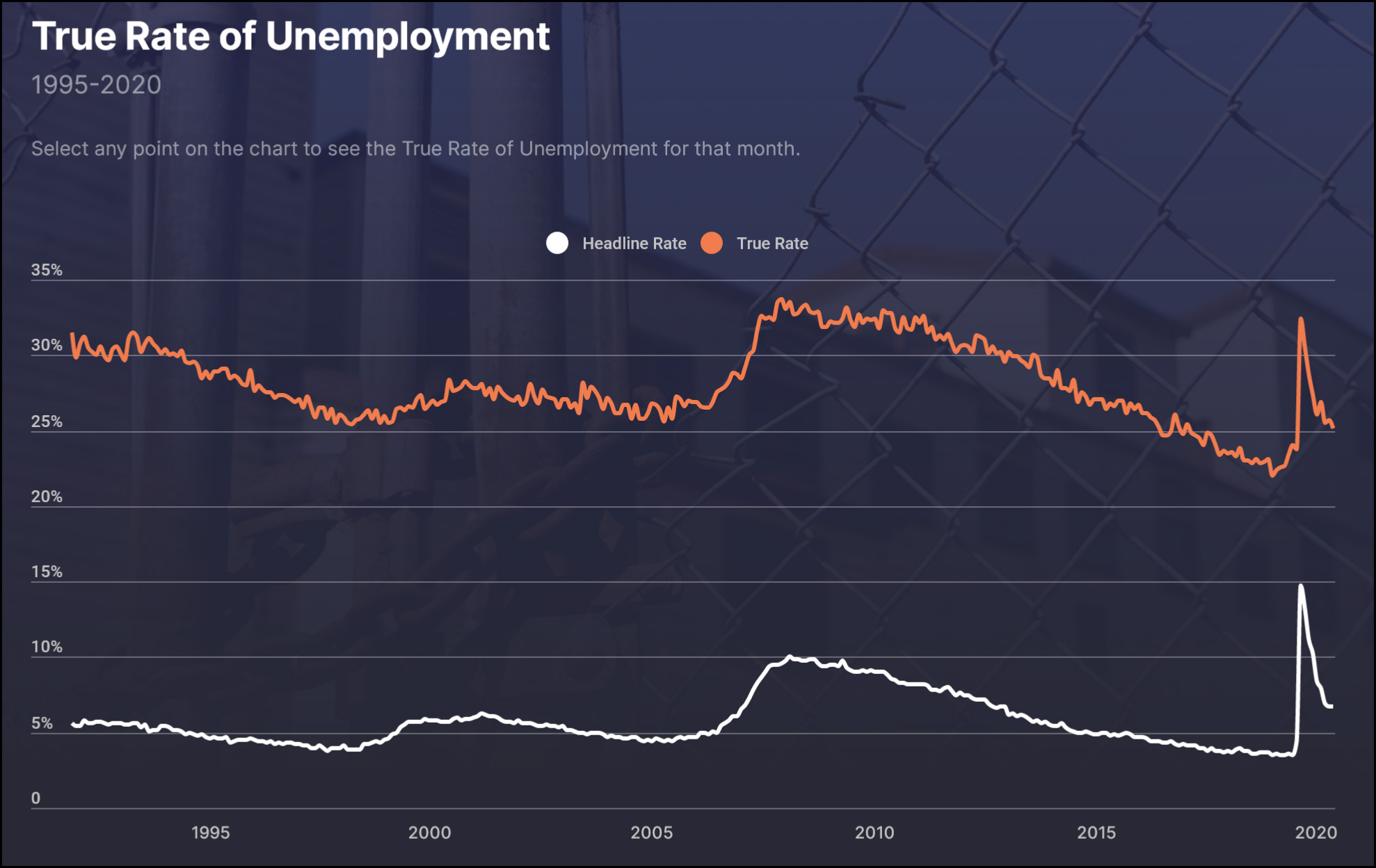
According to this chart, the evil headline rate shows that unemployment is about a point higher than it was in 1995. That seems reasonable. However, the TRU rate is five points lower than in 1995. Far from showing that unemployment is “much worse” than we think, it shows that unemployment has steadily declined. And unlike the headline rate, which shows the COVID-19 spike peaking at half again higher than the peak of the Great Recession, the TRU rate shows it spiking at a point lower than the peak of the Great Recession. In other words, unemployment is better than we think!

Bottom line: Pay no attention to this kind of stuff. You can prove anything you want by creating your own custom index of employment metrics. There’s nothing wrong with it if it helps to illustrate something interesting, but by no means do any of these things show that unemployment is “better” or “worse” than we think it is.

BEFORE YOU CLICK AWAY!

December is make or break for us. A full one-third of our annual fundraising comes in this month alone. A strong December means our newsroom is on the beat and reporting at full strength. A weak one means budget cuts and hard choices ahead.

The December 31 deadline is closing in fast. To reach our $400,000 goal, we need readers who’ve never given before to join the ranks of MoJo donors. And we need our steadfast supporters to give again today—any amount.

Managing an independent, nonprofit newsroom is staggeringly hard. There’s no cushion in our budget—no backup revenue, no corporate safety net. We can’t afford to fall short, and we can’t rely on corporations or deep-pocketed interests to fund the fierce, investigative journalism Mother Jones exists to do.

That’s why we need you right now. Please chip in to help close the gap.

BEFORE YOU CLICK AWAY!

December is make or break for us. A full one-third of our annual fundraising comes in this month alone. A strong December means our newsroom is on the beat and reporting at full strength. A weak one means budget cuts and hard choices ahead.

The December 31 deadline is closing in fast. To reach our $400,000 goal, we need readers who’ve never given before to join the ranks of MoJo donors. And we need our steadfast supporters to give again today—any amount.

Managing an independent, nonprofit newsroom is staggeringly hard. There’s no cushion in our budget—no backup revenue, no corporate safety net. We can’t afford to fall short, and we can’t rely on corporations or deep-pocketed interests to fund the fierce, investigative journalism Mother Jones exists to do.

That’s why we need you right now. Please chip in to help close the gap.

We Recommend

Latest

Sign up for our free newsletter

Subscribe to the Mother Jones Daily to have our top stories delivered directly to your inbox.

Get our award-winning magazine

Save big on a full year of investigations, ideas, and insights.

Subscribe

Support our journalism

Help Mother Jones' reporters dig deep with a tax-deductible donation.

Donate