Whale, Dolphin Deaths Twice Normal Rate in Gulf

Get your news from a source that’s not owned and controlled by oligarchs. Sign up for the free Mother Jones Daily.


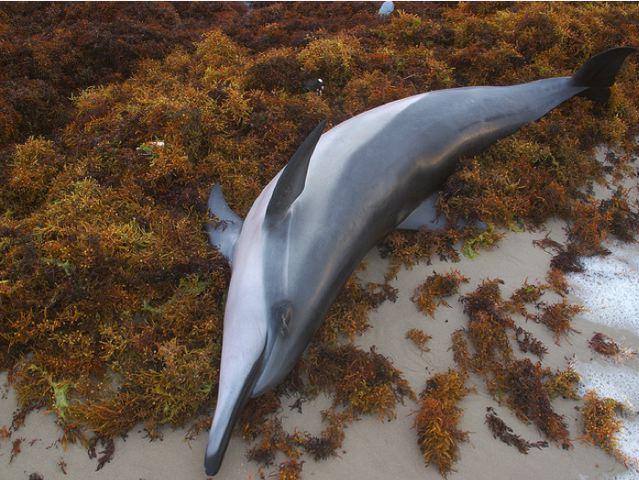
Stranded spinner dolphin.: Credit: qnr via Flickr.Stranded spinner dolphin.: Credit: qnr via Flickr. The latest NOAA report on unusual strandings of whales and dolphins in the northern Gulf of Mexico finds they’re still dying at twice the normal rate 18 months after BP’s Deepwater Horizon disaster.


Map of strandings in relation to Deepwater Horizon well.: Predicted heat index for Friday, 22 July, 2011. Credit: NOAA.Map of strandings in relation to Deepwater Horizon well Credit: NOAA.

As you can see in the map above, the most heavily oiled shoreline still corresponds with the most dead whales and dolphins. Bottlenose dolphins are shown as circles and other species as squares. Premature, stillborn, or neonatal bottlenose dolphins (with actual or estimated lengths of less than 115 cm/45 inches) are shown as a circle with a black dot inside. Pink points mark the most recent week of data. Green points mark are all other cases since January 1.
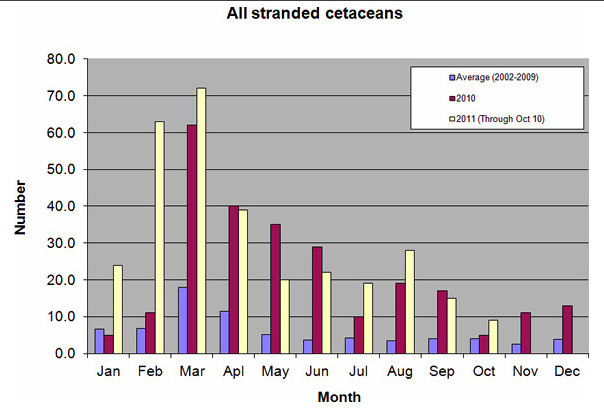
 All stranded cetaceans (dolphins and whales) from Franklin County, FL to the Texas/ Louisiana border.: Credit: NOAA.All stranded cetaceans (dolphins and whales) from Franklin County, Florida, to the Texas/Louisiana border Credit: NOAA.

Here you can see how the numbers of strandings have not yet stabilized or even begun to decline. In some cases they’re still growing. The magenta-colored bars mark strandings per month in the year 2010. The ivory-colored bars mark strandings per month so far this year.

In my Mother Jones article “The BP Cover-Uplast year, I wrote about the kind of long-term problems the Gulf might face not just from oil but from extreme quantities of oil in very deep water, as well as from chemical dispersant, including dispersant injected into very deep water.

Sadly, it seems that cetaceans—past, present, and future—may be bearing some of those burdens.

DECEMBER IS MAKE OR BREAK

A full one-third of our annual fundraising comes in this month alone. That’s risky, because a strong December means our newsroom is on the beat and reporting at full strength—but a weak one means budget cuts and hard choices ahead.

The December 31 deadline is closing in fast. To reach our $400,000 goal, we need readers who’ve never given before to join the ranks of MoJo donors. And we need our steadfast supporters to give again—any amount today.

Managing an independent, nonprofit newsroom is staggeringly hard. There’s no cushion in our budget—no backup revenue, no corporate safety net. We can’t afford to fall short, and we can’t rely on corporations or deep-pocketed interests to fund the fierce, investigative journalism Mother Jones exists to do.

That’s why we need you right now. Please chip in to help close the gap.

DECEMBER IS MAKE OR BREAK

A full one-third of our annual fundraising comes in this month alone. That’s risky, because a strong December means our newsroom is on the beat and reporting at full strength—but a weak one means budget cuts and hard choices ahead.

The December 31 deadline is closing in fast. To reach our $400,000 goal, we need readers who’ve never given before to join the ranks of MoJo donors. And we need our steadfast supporters to give again—any amount today.

Managing an independent, nonprofit newsroom is staggeringly hard. There’s no cushion in our budget—no backup revenue, no corporate safety net. We can’t afford to fall short, and we can’t rely on corporations or deep-pocketed interests to fund the fierce, investigative journalism Mother Jones exists to do.

That’s why we need you right now. Please chip in to help close the gap.

We Recommend

Latest

Sign up for our free newsletter

Subscribe to the Mother Jones Daily to have our top stories delivered directly to your inbox.

Get our award-winning magazine

Save big on a full year of investigations, ideas, and insights.

Subscribe

Support our journalism

Help Mother Jones' reporters dig deep with a tax-deductible donation.

Donate