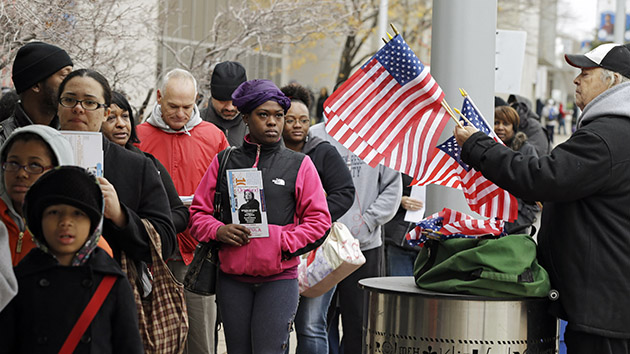
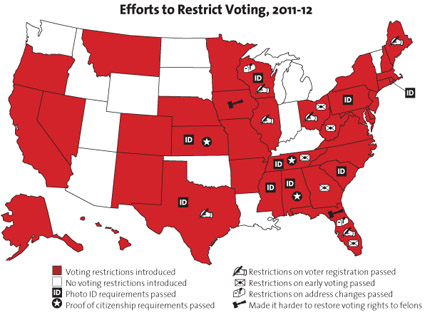
The recent wave of Republican-backed photo ID laws and restrictions on early and same-day voting have made it harder for people to head to the polls. But that’s not the only obstacle to casting a ballot in many precincts. On Election Day two years ago, some voters waited as long as five hours at their polling places. Long lines can depress voter turnout since many voters undoubtedly give up and leave without voting. According to the Cooperative Congressional Election Study, in 2012 minority voters, on average, waited longer to vote than white voters did. Nationwide, black voters waited about twice as long as whites.
The waits were especially long in areas with a high proportion of minority voters, according to a recent study by the Brennan Center for Justice. In Florida, Maryland, and South Carolina, which experienced some of the longest voting delays in 2012, precincts with greater populations of black and Latino voters tended to have significantly fewer voting machines and poll workers than whiter precincts. While unexpected voter turnout may have contributed to bottlenecks at polling places, the report’s authors conclude that local officials’ neglect and failure to prepare played a key, yet overlooked, role.
Take Florida, which experienced the longest voting delays in the country in 2012. In the 10 Florida precincts with the longest delays (which the Brennan Center measured using poll closing times) almost 70 percent of voters were Latino or black. (Most were in Miami-Dade County, home to some of the nation’s largest Latino communities.) Statewide, Latino and black voters make up about 30 percent of the population.
Additionally, the 10 Florida precincts with the worst delays also faced serious shortages of voting machines and poll workers. Florida, which has no requirements for the amount of voting resources allotted to each precinct, had an exceptionally high ratio of voters to machines and voters to poll workers compared with other states.
Similarly, in South Carolina, the 10 precincts that saw the longest wait times in 2012 were all in Richland County, where African Americans make up nearly half of the population. Out of the more than 30,000 registered voters in those precincts, 63 percent were African American, more than double the statewide rate.
Those precincts also had significantly fewer voting machines and poll workers, with almost double the number of registered voters per machine or poll worker than the statewide average. By law, the state requires of no more than one voting machine for every 250 voters, a limit which was introduced as part of the Voting Rights Act.
The authors of the Brennan Center report note that Maryland does not provide data on poll workers or demographic data on its registered voters. But there are still notable racial gaps in the available data. All of the 10 precincts which had the highest number of registered voters per machine in 2012 were located in affluent, predominantly African American Prince George’s County. The researchers found that P.G. County had the highest number of precincts which violated the state’s standard for machine allocation, with an average of 230 registered voters per machine.
As my colleague Stephanie Mencimer points out, the findings in Prince George’s County indicate that the uneven distribution of voting resources on Election Day is not necessarily about poor versus rich precincts, but rather an indication of a racial gap in how easy it is for Americans to exercise their right to vote.